Unknown's avatar

Posts by einnosys

eInnoSys is a global leader in Equipment Software & Fab Automation for Semiconductor, Solar(PV), LED, FPD and other related Electronics industries Experts at SECS/GEM, GEM300, Smart Factory & Industry 4.0

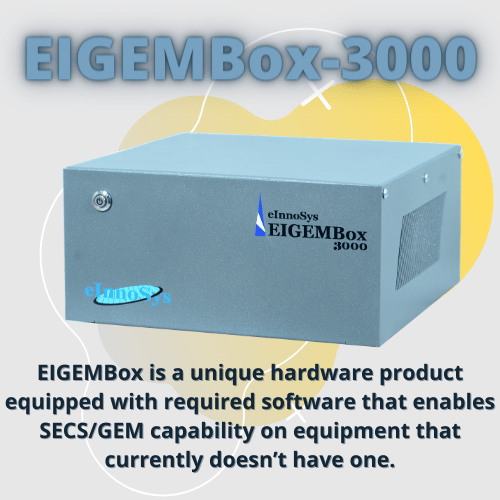
EIGEMBox-3000 SECS/GEM for Old/Legacy Equipment

EIGEMBox-3000 is a unique product that not only enables old/legacy equipment but also makes it “smart” by adding additional capabilities that are not part of the equipment, such as vibration and acoustics analysis.

Industry 4.0 represents the fourth revolution in manufacturing technology. It combines physical operations with digital technology such as machine learning, Industrial Internet of Things (IIoT), and big data to create a better-connected ecosystem for manufacturing and supply chain management, essentially creating cyber-physical systems. By creating interconnected systems, it allows better collaboration and access among various departments, partner, vendors, products, and customers.

The Industrial Internet of Things (IIoT) is a key aspect of the fourth industrial revolution. It connects sensors and machines to the internet, which enables deeper data analysis using Big Data, Machine Learning (ML), and Deep Learning (DL) technologies.

One of the big challenges for existing factories having equipment that is a few years or decades old is how to retrofit this equipment to enable smart manufacturing without spending a fortune and/or massive manufacturing disruption.

This is the problem EIGEMBox-3000 solves!

EIGEMBox-3000 is a unique product that extracts data from your existing equipment through screen captures, from external sensors through direct analog/digital I/O, and from wireless sensors through Wi-Fi or Bluetooth using standard industrial protocols such as Modbus, OPC, and MQTT. It seamlessly combines and analyzes data from various data sources and sends both raw and analyzed data to either the factory host, MES, a Cloud server or take automatic actions on the equipment.

Essentially, EIGEMBox converts your 20th-century equipment into a 21st-century one!

Sounds too good to be true? Call/Email us to schedule a demo.

Introduction to Multivariate SPC

A bunch of Advanced Techniques used for the monitoring and controlling of the operating performance of batch and continuous processes is known as Multivariate SPC (Multivariate Statistical Process Control Chart)

The most important benefit of multivariate SPC techniques is it reduces the information contained within all the process variables down to two or three composite metrics by implementing statistical modeling technique. These composite metrics can be monitored easily in real-time in order to benchmark the efficiency of the process and determine potential problems, thereby providing a platform for continuous improvements in the operation process.

As the complexity of products and processes increases and the amount of data grows, traditional unilabiate SPC and analytical tools may not be competent enough to provide the insight required by the engineers for their routine activities. Instead, they will need to understand and control processes which are listed by multiple variables, where the relations between the variables are not only complex but also often unknown. The most challenging aspect of this is to make statistical analysis of multiple interdependent variables, more efficient, intuitive, understandable and reliable as unilabiate SPC and analytics.

MULTIVARIATE CONTROL CHARTS:

Multivariate Charts are control charts for variables data. Multivariate Statistical Process Control Charts are used to detect shifts in the relationship (covariance) between several related parameters.

Various different control charts for variables data are available for Multivariate Statistical Process Control analysis:

T2 control charts for variables data, based upon the Hoteling T2 statistic, are used for Analysing shifts in the process. In Place of using the raw Process Variables, the T2 statistic is calculated for The main Components of the process, which are linear combinations of the Process Variables. While the Process Variables may be correlated with one another, the Principal Components are defined in a way so that they are independent, of one another, as required for the analysis.

The Squared Prediction Error (SPE) chart can be used to detect shifts. The SPE is based on the error between the raw data and a fitted PCA (Principal Component Analysis) model (a prediction) to that data.

Contribution Charts are available to as a certain the contributions of the Process Variables to either the Principal Component (Score Contributions) or the SPE (Error Contributions) for a given sample. This is particularly useful for determining the Process Variable that is responsible for process shifts.

Loading Charts give an indication of the relative contribution of each Process Variable towards a given Principal Component for all groups in the analysis.

Few restrictions are an application to these Multivariate Statistical Process Control analyses:

• The process variables are restricted to a subgroup of size one.

• Provision for missing data is not available. If a sample row has an empty cell, this will throw an error message, requiring that either the affected variable/sample should be dropped from the analysis.

• This process specifically excludes PLS (Partial Least Squares) analyses, where the samples for the process variables are linked with quality parameters.

Computer Integrated Manufacturing (CIM)

CIM – Computer Integrated Manufacturing is the approach in manufacturing for using computers to control the entire production process course.

The concept of CIM – Computer Integrated Manufacturing was conceptualized by Dr. Joseph Harrington in his book in the year 1974.

The CIM covers all the processes which are required to convert the customer requirements into output as per customers’ needs. According to U.S. National Research incorporating CIM into our process increases total productivity by 40-70 Percent. CIM decreases design cost by 15-20 Percent. It also reduces lead time by 20 – 60 percent and also cuts down work in progress by 30-60 Percent.

CIM process starts with product designing and ends with product sales.

CIM integration helps processes with information transfer with each other and initiate actions. Benefits of CIM are: Manufacturing can be faster and less error-prone as human intervention is minimal and computers take over the charge, the main advantage is the ability to create automated manufacturing processes. CIM relies mainly on closed-loop control processes, based on real-time input from sensors. This is also known as a flexible design and manufacturing process.

Computer-integrated manufacturing is implemented in the aviation, automotive, space and shipbuilding industries. The concept of “Computer Integrated Manufacturing” is not only a way of manufacturing but also a computer-automated system, where each engineering, production, marketing, and support functions of a manufacturing enterprise are planned efficiently.

In a CIM system, all the functional areas like designing, analysis, planning, purchasing, cost accounting, inventory control, and distribution are connected through the computer with factory floor functions such as materials handling and management, providing direct control and monitoring of all the operations.

As a method of manufacturing, three components distinguish CIM from other manufacturing methodologies:

The Components that distinguish CIM from other Manufacturing methodology’s are:

  • Means for data storage, Data retrieval, Data manipulation and the way it is presented
  • Mechanisms for sensing state and modifying processes.
  • Algorithms used for uniting the data processing component with the sensor/modification component.

CIM is a model of implementation of information and communication technologies (ICTs) in manufacturing. CIM implies that there are at least two computers involved in exchanging information, e.g. the micro-controller and the controller of an arm robot.

Parameters to be considered while incorporating CIM implementation in manufacturing are the production volume, the experience of the company or personnel to make the integration, the level of the integration into the product itself and the integration of the production processes.

CIM is useful where a high level of ICT is used in the facility, such as CAD/CAM systems, the availability of process planning and its data.

SECS/GEM Standards & CIM, (Computer Integrated Manufacturing) integration

SECS/GEM is the most widely used standard in Semiconductor Industry, this standard is adopted by chip manufactures all over the world. CIM-Computer Integrated Manufacturing System is used by high-tech chip manufacturing fabs not only to monitor the complete manufacturing process but is also used to control the whole manufacturing system.

Benefits of implementing CIM in any manufacturing unit are:


• It minimizes errors during the manufacturing process
• In turn, this brings down the production cost
• Improves products quality
• Improves delivery time

But the biggest challenge in the way of CIM implementation is that the as the manufacturing process is different, so not only the equipment being used for production are checked, but also the equipment from different manufacturers have different parameters. Thus this leads to CIM Automation Management even more difficult and complex.

As a standard business practice, when the suppliers supply Semiconductor Equipments, they also provide SECS/ GEM software interface to the fabs. But for Automation Software Integration, various equipment suppliers do not necessarily have a communication protocol.

Equipment suppliers at times do not open up communication protocol and do not provide interface software to semiconductor manufacturers, so semiconductor manufacturers have to build communication with the software in their own way, this leads to an increase in the programming expense and also requires additional time investment in this implementation process.

As there are different types of equipment for different manufacturers, only SECS/GEM can be used to comply with the management of the recipe as well as each different parameter. As the various recipe formats are verified by different suppliers, a lot of equipment encryption is difficult to be resolved, this leads to another exploitation by semiconductor manufacturers, referring to the SECS/GEM protocol. WCF (Windows Communication Foundation) is an application framework exploited by Microsoft, which is used to support data communication. So WCF is also called as Windows Communication Development Platform. Integrating the original Windows communication mechanism, which is most commonly known as .NET Removing, Web Service and Socket, and merging the technology related to HTTP and FTP, WCF is the best practice to develop distributed applications on Windows platform.