SECS/GEM compliance

Who can handle SECS/GEM compliance testing for my equipment?

Introduction

In semiconductor manufacturing, communication is everything. If your equipment can’t “talk” properly to a factory’s host system, it simply won’t make the cut. That’s why SECS/GEM (SEMI Equipment Communication Standard / Generic Equipment Model) compliance isn’t optional, it’s essential.

Achieving compliance ensures your equipment integrates seamlessly with global fabs. But navigating the standards, testing tools, and validation process can be challenging. So, who can handle SECS/GEM compliance testing for your equipment and how do you make sure it’s done right?

Understanding SECS/GEM Compliance Testing

What SECS/GEM Compliance Means

Think of SECS/GEM as the grammar and vocabulary of factory automation. The standards, including SEMI E4 (SECS-I), E5 (SECS-II), E30 (GEM), and E37 (HSMS) define how your tool communicates, reports data, and responds to host commands.

Compliance testing verifies that your equipment follows this “grammar” precisely, ensuring compatibility across different fabs and host systems. It’s what makes your machine plug-and-play in a global ecosystem.

Key Components of the Testing Process

Testing typically involves:

  • Message validation – ensuring messages match SEMI formats
  • Event and alarm verification – confirming correct reporting behavior
  • Data collection and control checks – validating that parameters and commands exchanged accurately

Engineers use host simulators (like einnosys, or SECSIM) to replicate fab environments. The goal is to confirm that your tool behaves consistently, no matter which host it connects to.

Common Testing Challenges

If SECS/GEM testing were simple, every equipment maker would breeze through it. But many stumble over:

  • Timing mismatches – when responses come too early or too late
  • Data mapping errors – incorrect variable definitions or data types
  • Incomplete implementation – missing events, messages, or states

Even small misalignments can create large integration delays. Fixing them early prevents costly rework later.

Key takeaway:
Compliance testing ensures your equipment is not just functional but fully fluent in SECS/GEM communication.

Who Can Perform SECS/GEM Compliance Testing

Equipment Manufacturers (OEMs)

Some OEMs handle testing internally. Their automation teams use host simulators to verify compliance before shipment. This in-house approach offers direct control but it can also stretch internal resources thin, especially if your engineers juggle multiple projects.

Third-Party Compliance Testing Providers

Independent experts specialize in SECS/GEM validation. They bring dedicated tools, standardized test plans, and deep protocol experience. Think of them as the “translators” who can quickly identify where your tool’s language might be off.

Third-party providers often uncover hidden gaps missed in internal tests, helping you avoid surprises during factory acceptance testing. They also keep up with evolving SEMI standards so you don’t have to.

Automation Software Vendors

Vendors that develop SECS/GEM communication libraries or middleware (like einnosys or PEER Group) often provide testing as part of their support services. Their advantage lies in deep familiarity with both protocol structure and integration logic. Working with them is like having the language’s author proofread your essay precisely and insightfully.

Key takeaway:
Whether in-house or outsourced, the best testing option is the one that saves you time while guaranteeing accuracy and global acceptance.

Choosing the Right SECS/GEM Testing Partner

Technical Expertise and SEMI Standards Knowledge

Would you trust a language tutor who doesn’t speak the dialect you’re learning? The same principle applies here. Your testing partner should have proven experience with SEMI E4, E5, E30, E37, and E39 plus a portfolio of past projects.

Ask for case studies or customer testimonials that demonstrate success with similar equipment.

Tools and Testing Infrastructure

The right tools matter. Certified host simulators, SECS/GEM test beds, and automated result tracking ensure your compliance testing is both thorough and repeatable. A well-equipped partner can simulate real fab conditions and validate your equipment against a wide range of host systems.

Comprehensive Documentation and Support

Testing isn’t just about passing or failing, it’s about learning. A strong partner will deliver detailed logs, root-cause analysis, and practical recommendations for fixes. The process should empower your engineers to strengthen future products, not just check a compliance box.

Key takeaway:
Choose a partner who brings not just tools, but understanding, helping your team build confidence and repeatable compliance success.

Conclusion

SECS/GEM compliance testing isn’t just a step in production it’s the key to unlocking seamless communication with every fab worldwide. Working with experienced testing partners ensures your equipment performs flawlessly, integrates quickly, and meets the industry’s highest standards.

By investing in professional SECS/GEM testing, you’re not just checking a compliance box, you’re building trust, efficiency, and long-term readiness in an ever-evolving semiconductor landscape.

Frequently Asked Questions

1. What is SECS/GEM compliance, and why is it important?

SECS/GEM compliance ensures that your semiconductor equipment can communicate effectively with a factory’s host system using standardized SEMI protocols. It’s essential for equipment integration, automation, and traceability. Without compliance, your tool may fail to connect properly with fab systems, leading to production delays or rejection.

2. How long does SECS/GEM compliance testing usually take?

Testing duration depends on your equipment’s complexity and current implementation quality. For a well-prepared system, initial validation may take a few days. However, full compliance testing, debugging, and revalidation can extend to several weeks. Working with an experienced testing provider helps streamline the process.

3. Can SECS/GEM testing be done in-house?

Yes, many OEMs perform initial SECS/GEM testing in-house using host simulators and test scripts. However, third-party validation is highly recommended to ensure objectivity, identify hidden issues, and guarantee that your equipment meets global fab standards before delivery.

4. What tools are used for SECS/GEM compliance testing?

Commonly used tools include Cimetrix CIMConnect, Einnosys SECS/GEM and EDA solutions, and SECSIM host simulators. These tools emulate factory host systems, verify communication messages, and log all interactions for analysis ensuring your interface adheres to SEMI standards like E4, E5, E30, and E37.

5. How do I choose the right SECS/GEM testing partner?

Look for partners with proven SEMI standards expertise, certified testing tools, and a strong track record in the semiconductor industry. They should provide detailed test reports, issue diagnostics, and post-test support, not just a simple pass/fail result. A capable partner helps you achieve compliance efficiently and confidently.

More Blog Post

Are You Facing Challenges with the SECS/GEM Functionality Delivered by Your OEM?

In today’s highly automated semiconductor manufacturing environment, seamless communication between equipment and factory control systems is not just a luxury—it’s a necessity. The SECS/GEM protocol (Semiconductor Equipment Communication Standard / Generic Equipment Model) is the backbone of this communication, enabling standardized data exchange, remote control, and real-time monitoring. Yet, many manufacturers find themselves grappling with SECS/GEM functionality delivered by their OEM, encountering issues that hinder productivity and delay operations.

Whether it’s a Host communication failure, SECS message timeout, or persistent Equipment interface issues, these problems can quickly escalate into costly downtime. Worse, they often reveal deeper gaps in GEM compliance, leaving fabs unable to meet industry standards or scale automation effectively.

Common Challenges with OEM SECS/GEM Implementations

One of the most frequent complaints from fab engineers is the lack of robustness in OEM-provided SECS/GEM setups. While most equipment vendors offer basic SECS/GEM functionality, these implementations are often rigid, outdated, or poorly integrated with host systems. This leads to a cascade of problems:

Host communication failure: When the host system cannot reliably connect or exchange data with the equipment, it disrupts everything from recipe downloads to alarm reporting.

SECS message timeout: Delays or dropped messages between host and equipment can cause critical operations to stall, especially during high-volume production runs.

Equipment interface issues: Inconsistent or incomplete data structures, missing variables, or unsupported commands make it difficult to maintain a stable interface.

GEM compliance gaps: Without full adherence to GEM standards, manufacturers lose access to key features like remote command execution, event reporting, and trace data collection.

These issues don’t just affect performance—they undermine trust in the OEM’s ability to deliver scalable, future-proof automation. As fabs push toward Industry 4.0, the need for reliable SECS/GEM protocol support becomes even more urgent.

Why SECS/GEM Functionality Matters More Than Ever

Modern fabs rely on SECS/GEM functionality to orchestrate complex workflows, monitor equipment health, and respond to real-time events. When the SECS/GEM functionality delivered by your OEM falls short, it creates bottlenecks that ripple across the entire production line.

For example, a SECS message timeout during a process program load can delay wafer processing, while a failed Host communication attempt might prevent critical alarms from reaching the MES (Manufacturing Execution System). These aren’t just technical glitches—they’re operational risks.

Moreover, GEM compliance is essential for interoperability. Without it, integrating third-party tools, analytics platforms, or AI-driven optimization engines becomes a nightmare. Manufacturers need flexible, standards-based communication to remain competitive, and that starts with a robust SECS/GEM protocol implementation.

What You Can Do About It

If you’re experiencing persistent Equipment interface issues or suspect your OEM’s system isn’t fully compliant, it may be time to explore alternative solutions. Third-party SECS/GEM platforms often offer:

Enhanced diagnostics to pinpoint SECS message timeouts and communication failures.

Customizable interfaces that adapt to your fab’s unique requirements.

Full GEM compliance with support for all standard commands, events, and data structures.

Plug-and-play integration with legacy tools and modern host systems.

By upgrading your SECS/GEM functionality, you can eliminate Host communication failures, reduce downtime, and unlock new levels of automation. It’s not just about fixing bugs—it’s about future-proofing your operations.

Don’t Let OEM Limitations Hold You Back

The SECS/GEM protocol is a powerful enabler of smart manufacturing, but only when implemented correctly. If you’re facing SECS message timeouts, Equipment interface issues, or struggling with GEM compliance, the problem may lie in the SECS/GEM functionality delivered by your OEM. Don’t settle for subpar performance—explore solutions that offer reliability, flexibility, and full standards support.

Your fab deserves better. And with the right tools, you can make SECS/GEM work for you—not against you.

Blog Post:

How does SECS/GEM enhance interoperability between different manufacturing equipment?

How has SECS/GEM been adapted for use in industries beyond semiconductor manufacturing?

What service providers offer SECS/GEM protocol implementation for semiconductor factories?

Step-by-Step: How to Integrate SECS/GEM with Leading Cloud Platforms

How Does SECS/GEM Integrate with Protocols like OPC UA and MQTT?

In the era of Industry 4.0 and smart manufacturing, seamless data communication between equipment and host systems has become essential for achieving efficiency, transparency, and automation. The SECS/GEM communication protocol has long been the backbone of semiconductor manufacturing, enabling standardized connectivity between tools and factory control systems. However, as industries expand toward IoT-based architectures, integrating SECS/GEM with modern protocols like OPC UA and MQTT has become a critical step toward interoperability and real-time data sharing. This convergence bridges the gap between traditional automation systems and next-generation industrial IoT platforms.

Bridging Traditional and Modern Communication Standards

The SECS/GEM integration framework defines how equipment communicates process, event, and status information to host systems, ensuring a uniform interface for factory automation. Meanwhile, OPC UA and MQTT represent the new wave of connectivity protocols designed for cloud-based and distributed manufacturing environments. OPC UA supports secure, object-oriented communication for industrial devices, while MQTT offers lightweight, publish-subscribe messaging ideal for IoT applications.

By combining SECS/GEM and OPC UA, manufacturers can extend legacy tool data to enterprise and cloud applications without replacing existing systems. For instance, an SECS/GEM software solution can act as a middleware layer that translates GEM events into OPC UA data models. This ensures older tools become part of a modern, connected ecosystem—enabling visibility, analytics, and control from any platform.

Similarly, SECS/GEM and MQTT integration allows real-time data to flow between factory floor devices and cloud-based systems efficiently. MQTT’s bandwidth-efficient design makes it perfect for sharing GEM data across geographically distributed facilities. Through such integration, manufacturers gain access to predictive insights, remote monitoring, and intelligent automation capabilities.

How SECS/GEM Works with OPC UA and MQTT

To understand how SECS/GEM integration services connect with OPC UA and MQTT, consider the role of a gateway or translator. These systems capture data generated by the equipment’s SECS/GEM communication protocol, convert it into standardized formats like JSON or OPC UA nodes, and publish it to higher-level systems such as MES, ERP, or analytics platforms.

When SECS/GEM and OPC UA are integrated, each GEM event or variable is mapped to an OPC UA object. This mapping enables real-time synchronization between machine states and upper-level monitoring applications. As a result, engineers can access comprehensive datasets, from process parameters to equipment alarms, through a secure and unified interface.

On the other hand, SECS/GEM and MQTT integration leverages broker-based architecture to send messages from equipment to cloud or edge computing nodes. Using an SECS/GEM software solution, data packets such as recipe downloads, process start/stop events, and performance metrics are published as MQTT topics. Subscribers—whether MES systems or AI-powered dashboards—can consume this data instantly for decision-making and optimization.

This interoperability not only extends the lifespan of legacy systems but also simplifies the digital transformation journey for semiconductor and electronics manufacturers adopting modern IIoT technologies.

Benefits of SECSGEM Integration with OPC UA and MQTT

Benefits of SECS/GEM Integration with OPC UA and MQTT

The synergy between SECS/GEM and OPC UA or SECS/GEM and MQTT delivers multiple benefits to manufacturers:

Enhanced Interoperability: Seamless communication between legacy GEM-enabled tools and modern cloud systems improves equipment integration and process control.

Real-Time Data Accessibility: Continuous, bi-directional data flow supports advanced analytics, predictive maintenance, and AI-driven insights.

Reduced Costs: Instead of replacing existing infrastructure, SECS/GEM integration services allow for incremental upgrades—saving both time and resources.

Scalability: SECS/GEM software solutions combined with MQTT’s lightweight messaging make it easier to scale data communication across multi-site operations.

Future-Proofing: Integrating these protocols future-proofs manufacturing environments by enabling flexible connectivity for emerging Industry 4.0 standards.

As the industrial landscape evolves, connecting traditional automation frameworks with modern IoT and cloud technologies becomes imperative. SECS/GEM integration with OPC UA and MQTT bridges the old and the new—offering manufacturers a robust path toward digital transformation. Whether through an SECS/GEM software solution or specialized SECS/GEM integration services, this approach ensures that every piece of equipment, new or legacy, can communicate intelligently within a connected, data-driven factory ecosystem.

In short, the collaboration between SECS/GEM and OPC UA, as well as SECS/GEM and MQTT, marks a significant milestone in smart manufacturing—one that drives efficiency, agility, and innovation across global production lines.

More Blog Post:

Is your equipment lacking the full potential of SECS/GEM integration provided by your OEM?

Where Can I Find Experts for SECS/GEM Software Integration?

How does SECS/GEM benefit semiconductor manufacturing processes

How do you get data from pre-GEM equipment into your MES?

How Does SECS/GEM Benefit Semiconductor Manufacturing Processes?

Semiconductor manufacturing is one of the most complex and high-precision industries in the world. With increasing demand for smaller, faster, and more powerful chips, factories need seamless communication and automation to maintain efficiency. This is where SECS/GEM (SEMI Equipment Communication Standard / Generic Equipment Model) comes into play. The SECS/GEM Protocol enables standardized communication between manufacturing equipment and host systems, providing manufacturers with greater control, data collection, and automation. By adopting SECS/GEM, semiconductor fabs can streamline processes, ensure traceability, and enhance productivity while reducing errors.

Understanding SECS/GEM Protocol

The SECS/GEM Protocol is an industry standard developed by SEMI (Semiconductor Equipment and Materials International). It defines how manufacturing equipment communicates with host systems using either SECS-I (RS232-based) or HSMS (Ethernet-based) connections. This protocol ensures that machines from different vendors can interact seamlessly with factory automation software.

At its core, SECS/GEM enables functions such as:

Equipment status monitoring

Remote start/stop control

Data collection and reporting

Alarm and event notifications

Recipe management for consistent production

These capabilities make the SECS GEM protocol a foundation for advanced factory automation in semiconductor fabs.

Benefits of SECS/GEM in Semiconductor Manufacturing

  1. Seamless Equipment Communication

One of the most significant advantages of SECS/GEM is standardized communication. In a semiconductor fab, hundreds of machines operate simultaneously. The SECS/GEM Communication Protocol ensures that equipment from different suppliers can communicate with the host system, enabling consistent operations across the entire facility.

  1. Real-Time Data Collection and Monitoring

SECS/GEM allows factories to collect equipment data in real time. This supports predictive analytics, advanced process control, and equipment health monitoring. With SECS/GEM Software, engineers can detect performance issues before they lead to downtime, saving both time and costs.

  1. Improved Automation and Efficiency

Automation is critical for reducing human error in semiconductor production. By implementing SECS/GEM Interface solutions, fabs can execute recipes, control processes, and monitor alarms automatically. This improves throughput and ensures products meet stringent quality standards.

  1. Compliance with GEM300 Standards

Modern semiconductor fabs, especially 300mm fabs, rely on GEM300 standards, which extend the SECS/GEM framework for fully automated material handling. GEM300 compliance ensures that wafer transport, process scheduling, and equipment utilization are highly efficient.

  1. Easier Integration with Factory Systems

With SECS/GEM Integration, fabs can connect equipment with MES (Manufacturing Execution Systems), EDA (Equipment Data Acquisition), and predictive maintenance tools. This unified ecosystem reduces integration costs and simplifies factory operations.

Real-World Applications of SECS/GEM

The use of SECS/GEM Communication extends beyond basic machine control. Semiconductor fabs use it for:

Process traceability: Ensuring every wafer can be tracked from start to finish.

Alarm management: Automatically detecting and addressing equipment issues.

Yield improvement: Using real-time data to optimize recipes and process parameters.

Predictive maintenance: Reducing unexpected downtime by analyzing equipment health data.

For example, when a wafer polishing tool or etching machine is connected via SECS/GEM, the host can immediately collect process data, monitor tool performance, and adjust parameters. This ensures higher yield and consistent product quality.

Why SECS/GEM Is Essential for the Future

As semiconductor manufacturing advances toward AI-driven fabs and smart factories, the role of SECS/GEM becomes even more critical. Future-ready fabs require:

Integration with AI/ML-based predictive analytics.

Connectivity with IoT-enabled equipment.

Support for smart manufacturing and Industry 4.0 initiatives.

By implementing the SECS GEM protocol, fabs can ensure long-term compatibility and scalability while staying ahead in a competitive industry.

The semiconductor industry cannot afford inefficiencies or communication gaps in its manufacturing processes. The SECS/GEM Protocol provides a standardized way to connect equipment and host systems, making it the backbone of automation in modern fabs. From real-time data collection and predictive maintenance to compliance with GEM300 standards, SECS/GEM offers unmatched benefits. Whether it’s improving equipment utilization, reducing downtime, or enabling smart manufacturing, SECS/GEM continues to revolutionize semiconductor production.

By leveraging SECS/GEM Software, Interfaces, and Integration, fabs can achieve higher efficiency, reduced operational costs, and better product quality — positioning themselves for future success in the ever-evolving semiconductor market.

How does SECS/GEM facilitate communication in smart factories

Who offers customized SECS/GEM interface development for manufacturing equipment?

What service providers offer SECS/GEM protocol implementation for semiconductor factories?

SECS/GEM Protocol Drivers and Development Tools: Building Smarter Fab Connectivity

Why Factory Automation is Essential for the Future of Manufacturing

In today’s rapidly evolving industrial landscape, factory automation has emerged as a crucial component for manufacturing success. By integrating advanced technologies, manufacturers can enhance productivity, ensure consistent quality, and remain competitive in a global market. Here, we explore why factory automation is essential for the future of manufacturing.

Increased Efficiency and Productivity

Factory automation significantly boosts efficiency and productivity by minimizing human error and optimizing production processes. Automated systems can operate 24/7, unlike human workers who require breaks and are prone to fatigue. This continuous operation leads to higher output rates and faster production cycles, enabling manufacturers to meet increasing demand without compromising quality.

Improved Quality and Consistency

Automated systems ensure that every product is manufactured to the same high standard, reducing variability and enhancing overall quality. Precision machinery and advanced robotics can perform tasks with a level of accuracy that is difficult for human workers to achieve consistently. This uniformity is particularly vital in industries where even minor deviations can lead to significant issues, such as in electronics or pharmaceuticals.

Cost Reduction

While the initial investment in factory automation can be substantial, the long-term cost savings are significant. Automation reduces labor costs, decreases waste, and minimizes the need for rework due to errors. Additionally, automated systems can optimize energy usage, contributing to lower utility bills and a smaller carbon footprint.

Enhanced Safety

Factory automation can significantly improve workplace safety by taking over dangerous or repetitive tasks. Robots and automated systems can handle hazardous materials, operate heavy machinery, and perform tasks in extreme environments, reducing the risk of injury to human workers. By ensuring that employees are not exposed to potential hazards, manufacturers can create a safer working environment and comply with stringent safety regulations.

Adaptability and Flexibility

Modern automated systems are highly adaptable and can be reprogrammed to accommodate different products and production processes. This flexibility allows manufacturers to respond quickly to market changes, customer demands, and new opportunities. By leveraging automation, factories can produce a wide range of products without extensive retooling, making it easier to innovate and stay ahead of competitors.

Data Collection and Analysis

Automation technologies, such as the Internet of Things (IoT) and machine learning, enable the collection and analysis of vast amounts of data from the production floor. This data can provide valuable insights into process performance, equipment health, and product quality. By analyzing this data, manufacturers can identify bottlenecks, predict maintenance needs, and implement continuous improvements, leading to greater efficiency and reduced downtime.

Sustainability

As environmental concerns become increasingly important, factory automation can play a key role in promoting sustainability. Automated systems can optimize resource use, reduce waste, and improve energy efficiency. Additionally, automation can facilitate the adoption of green manufacturing practices, such as recycling and the use of renewable energy sources, helping manufacturers meet environmental standards and reduce their environmental impact.

FAB Systems Reviews

FAB (Factory Automation and Building) systems are at the forefront of this technological revolution, providing integrated solutions that enhance manufacturing processes. Here’s a review of how FAB systems are transforming factories:

Advanced Robotics: FAB systems incorporate state-of-the-art robotics that can perform complex tasks with high precision and speed. These robots are essential for assembly lines, packaging, and quality control, ensuring that products meet stringent standards.

Smart Sensors: FAB systems use smart sensors to monitor various parameters, such as temperature, pressure, and humidity. These sensors provide real-time data, enabling manufacturers to make informed decisions and maintain optimal production conditions.

IoT Integration: By integrating IoT technologies, FAB systems can connect different parts of the production process, creating a seamless flow of information. This connectivity allows for better coordination, faster response times, and improved overall efficiency.

Predictive Maintenance: FAB systems use predictive maintenance techniques to monitor equipment health and predict potential failures. This proactive approach reduces downtime, extends the lifespan of machinery, and lowers maintenance costs.

User-Friendly Interfaces: FAB systems are designed with user-friendly interfaces that make it easy for operators to monitor and control the production process. These interfaces provide intuitive controls, detailed analytics, and customizable dashboards, enhancing operational visibility and decision-making.

Factory automation is not just a trend; it is a necessity for the future of manufacturing. By embracing automation technologies, manufacturers can achieve higher efficiency, improved quality, reduced costs, enhanced safety, and greater adaptability. FAB systems are leading the way in this transformation, offering innovative solutions that integrate advanced robotics, IoT, and smart sensors. As the manufacturing industry continues to evolve, the adoption of factory automation will be key to staying competitive and meeting the demands of the modern market.

For those looking to stay ahead in the manufacturing game, investing in factory automation and FAB systems is not just an option—it’s essential.

Optimizing Semiconductor Production: Unleashing Efficiency with SECS/GEM Integration on Takatori ATM-8200A

Elevate Your Semiconductor Production Efficiency with EIGEMBox

In the dynamic landscape of semiconductor manufacturing, achieving peak operational efficiency is paramount. One breakthrough solution that stands at the forefront of this transformation is the integration of SECS/GEM on Takatori ATM-8200A, powered by our innovative EIGEMBox technology.

Unlocking Seamless Communication

The Semiconductor Equipment Communication Standard (SECS) and Generic Equipment Model (GEM) integration play a pivotal role in facilitating seamless communication between manufacturing equipment and factory host systems. The Takatori ATM-8200A, renowned for its precision and reliability in wafer processing, becomes even more powerful with the incorporation of SECS/GEM.

Enhanced Data Management and Control

With SECS/GEM integration, the Takatori ATM-8200A gains enhanced data management capabilities. Real-time data exchange, remote monitoring, and advanced control features empower semiconductor manufacturers to maintain precision, detect anomalies swiftly, and optimize production parameters.

Reduced Downtime, Increased Productivity

The integration ensures minimized downtime through proactive monitoring and rapid response mechanisms. Unplanned downtimes are costly in semiconductor manufacturing, and SECS/GEM integration on Takatori ATM-8200A mitigates this risk, resulting in enhanced overall productivity.

Customized Solutions for Your Facility

Our EIGEMBox technology doesn’t offer a one-size-fits-all solution. We understand that each semiconductor manufacturing facility has unique requirements. Therefore, our SECS/GEM integration on Takatori ATM-8200A is customized to meet the specific needs of your production environment, ensuring optimal performance.

Future-Ready Manufacturing

As the semiconductor industry evolves, being future-ready is imperative. SECS/GEM integration on Takatori ATM-8200A future-proofs your manufacturing processes, ensuring compatibility with emerging technologies and Industry 4.0 standards.

Elevate Your Semiconductor Manufacturing Today!

Ready to take your semiconductor manufacturing to the next level? Embrace the future with SECS/GEM integration on Takatori ATM-8200A through our cutting-edge EIGEMBox Contact us now to explore how this revolutionary solution can transform your production capabilities, reduce costs, and position your facility for success in the ever-evolving semiconductor landscape. Don’t miss out on the opportunity to lead the way in semiconductor manufacturing efficiency!

Invest in innovation. Transform with technology. Elevate your semiconductor manufacturing with EIGEMBox.

Smart Connected Equipment Software Solutions for SECS/GEM: Advancing Manufacturing Efficiency

The world of manufacturing is evolving rapidly, with a growing emphasis on smart technologies and interconnected systems. Among the driving forces behind this transformation is the adoption of SECS/GEM (SEMI Equipment Communications Standard/Generic Equipment Model) – a standardized communication protocol that enables seamless integration and data exchange between manufacturing equipment and factory automation systems. In this blog post, we will explore how smart connected equipment software solutions are leveraging SECS/GEM to revolutionize manufacturing efficiency.

Understanding SECS/GEM: The Backbone of Smart Manufacturing

SECS/GEM acts as a crucial enabler in smart manufacturing environments, allowing equipment to communicate in real-time with higher-level systems. This standard protocol facilitates data sharing, remote monitoring, and control, empowering manufacturers to make informed decisions and optimize production processes. By embracing SECS/GEM, manufacturing companies can transform traditional equipment into intelligent, connected assets, leading to increased productivity and reduced downtime.

The Rise of Smart Connected Equipment Software Solutions

With the growing demand for advanced manufacturing capabilities, smart connected equipment software solutions are gaining prominence. These solutions offer a range of features that enhance the functionality of SECS/GEM-enabled equipment, taking manufacturing to new heights.

Some key features include:

A. Real-Time Monitoring: Smart connected equipment software solutions provide real-time monitoring of equipment performance, production status, and critical parameters. This allows manufacturers to identify and address issues promptly, minimizing disruptions and downtime.

B. Predictive Maintenance: Leveraging data analytics and machine learning algorithms, these solutions enable predictive maintenance. By analyzing equipment data, manufacturers can proactively schedule maintenance activities, reducing unexpected breakdowns and maximizing equipment uptime.

C. Process Optimization: Smart connected equipment software solutions use historical and real-time data to optimize production processes. By analyzing data trends, manufacturers can fine-tune manufacturing parameters for improved efficiency and quality.

D. Remote Control and Management: With the ability to remotely control and manage equipment, manufacturers can streamline operations, regardless of the physical location of the machinery. This level of control fosters flexibility and agility in production.

Advantages of Smart Connected Equipment Software Solutions

A. Enhanced Efficiency: By integrating smart connected equipment solutions with SECS/GEM, manufacturers can achieve unparalleled levels of efficiency. Streamlined processes, reduced downtime, and optimized production contribute to increased overall output.

B. Improved Quality: The real-time monitoring and process optimization capabilities of these solutions lead to improved product quality and consistency. Manufacturers can quickly detect and rectify deviations in manufacturing, ensuring that products meet stringent quality standards.

C. Cost Savings: Predictive maintenance and reduced downtime translate into significant cost savings for manufacturers. Minimized equipment breakdowns and optimized resource utilization lead to better operational efficiency and cost-effectiveness.

D. Future-Proofing: Investing in smart connected equipment solutions future-proofs manufacturing operations. These solutions provide the flexibility to adapt to technological advancements and industry changes, ensuring long-term competitiveness.

Conclusion

Smart connected equipment software solutions, powered by SECS/GEM, are redefining manufacturing efficiency and productivity. By harnessing real-time monitoring, predictive maintenance, and process optimization capabilities, manufacturers can achieve significant cost savings, improved product quality, and a competitive edge in the global market. As smart manufacturing continues to evolve, embracing these innovative solutions becomes imperative for any forward-thinking manufacturing company looking to thrive in the Industry 4.0 era.

Challenges and Solutions in Adopting Predictive Maintenance in Semiconductor Manufacturing

The semiconductor manufacturing industry plays a critical role in producing the electronic components that power our modern world. To ensure efficient operations and prevent costly downtime, many semiconductor manufacturers are adopting predictive maintenance techniques. However, this transition is not without its challenges. In this blog post, we will explore the key challenges faced by semiconductor manufacturers in adopting predictive maintenance and discuss potential solutions to overcome them.

Complexity of Data Management:

Predictive maintenance relies heavily on data collection and analysis. In semiconductor manufacturing, numerous sensors and monitoring devices generate massive amounts of data, making it challenging to manage and analyze effectively. Additionally, data may exist in various formats and come from disparate sources, further complicating the process.

Solution:

To address data management challenges, semiconductor manufacturers should invest in robust data infrastructure and analytics platforms. Implementing a centralized data repository and utilizing data integration techniques can help consolidate and standardize data from different sources. Advanced analytics tools, such as machine learning algorithms and artificial intelligence, can then be applied to extract meaningful insights from the data.

Data Quality and Integrity:

The accuracy and reliability of the data collected are crucial for the success of predictive maintenance initiatives. In semiconductor manufacturing, ensuring data quality and integrity can be difficult due to factors like sensor drift, noise, and inconsistencies across different equipment.

Solution:

To improve data quality, manufacturers should establish comprehensive data validation and cleansing processes. This involves regularly calibrating sensors, identifying and rectifying anomalies, and implementing quality checks throughout the data collection and analysis pipeline. By maintaining a high standard of data integrity, semiconductor manufacturers can enhance the effectiveness and reliability of predictive maintenance.

Equipment Heterogeneity:

Semiconductor manufacturing facilities often house a wide range of equipment, each with its unique specifications and requirements. Integrating predictive maintenance across diverse equipment types can be challenging, as different machines may generate different types of data or operate under distinct conditions.

Solution:

To address equipment heterogeneity, manufacturers should conduct a thorough inventory and analysis of their equipment. By categorizing machines based on their criticality, complexity, and data requirements, they can prioritize the implementation of predictive maintenance strategies. Developing customized predictive maintenance models for specific equipment types and leveraging condition monitoring techniques can also streamline the adoption process.

Knowledge and Expertise Gap:

Predictive maintenance requires a deep understanding of both data analytics and the semiconductor manufacturing process. However, many manufacturers may lack the necessary expertise and knowledge to implement and interpret predictive maintenance systems effectively.

Solution:

To bridge the knowledge gap, semiconductor manufacturers should invest in training programs for their maintenance and data analysis teams. Collaborating with external experts, consultants, or solution providers specializing in predictive maintenance can also bring valuable insights and guidance. By upskilling their workforce and seeking external expertise, manufacturers can ensure a smooth adoption of predictive maintenance practices.

Conclusion:

Predictive maintenance has the potential to revolutionize semiconductor manufacturing by optimizing equipment reliability, reducing downtime, and improving overall productivity. However, the adoption process comes with its fair share of challenges. By addressing the complexities of data management, focusing on data quality, considering equipment heterogeneity, and investing in knowledge enhancement, semiconductor manufacturers can overcome these challenges and unlock the benefits of predictive maintenance. Embracing this transformative approach will empower manufacturers to stay competitive in the dynamic semiconductor industry of today and tomorrow.

Remember, this blog post is a starting point, and you can further expand on each challenge and solution based on your specific industry knowledge and research.

Predictive Maintenance For Factory : https://www.einnosys.com/seersight-predictive-maintenance-for-factory/

EIGEMSim Software Toolkit – Software to Implement GEM (SECS/GEM) Communication

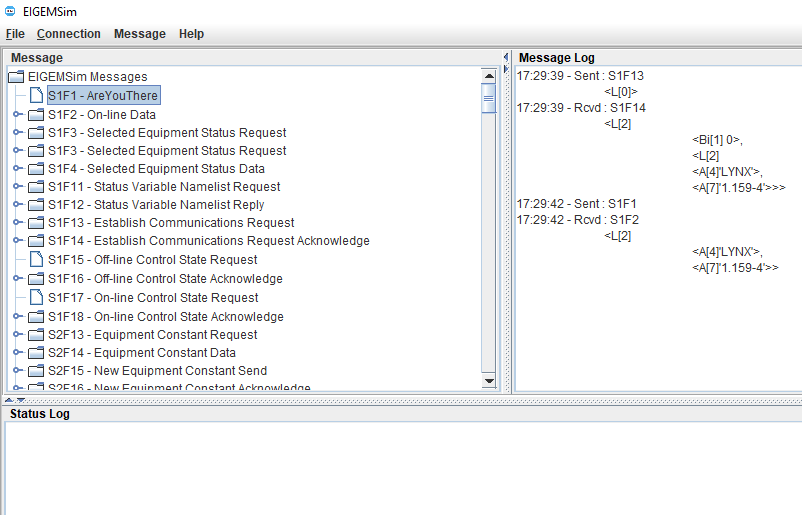
EIGEMSim is a software that is used for testing SECS/GEM compliance of your equipment software. It simulates Factory Host with most SECS messages that are used for testing pre-bundled.

FEATURES OF EIGEMSim

  • Configurable to simulate factory host or equipment
  • Multi-platform support – Linux/Unix or Windows
  • Intuitive UI for configuring and sending SECS messages
  • Comes bundled with most SECS messages needed for testing
  • Logs of all incoming and outgoing SECS messages

Why EIGEMSIM.?

  • If you’re a factory you need the EIGEMSIM.
  • If you’re an Equipment Manufacturer you need the EIGEMSIM.
  • If you’re an Automation Developer you need the EIGEMSIM.
  • All industrial automation compatibility is capable with different in built test scenarios!

If you’re a factory

Machine and the Factory Systems will have to communicate for the purpose of automation! When a new machine comes into a factory suppose you have 1000 machines at a time in a factory!

and you, when you are developing an application you first time, and need something that you know, is already working!

that you can use to test the communication with the machine!

Just to make sure that the communication with the machine is working! Proven Protocols

For that Purpose, after you verify the communication and the output to input accuracy, Now you develop your application and Develop those commands. basically But before you do the whole development and Deployment you need a SECS/GEM Tester & Simulator or a tool to test the communication! and the protocols installed in the machine or factory MES! Here EIGEM SIM Comes in Advanced Requirements!


Protocol which is the communication language of machines and the factory systems can be a prototype and tested!
and for those purposes, you use a simulator or a testing tool! which is what EIGEM SIM is, Here you can use it both ways!

So if you have a machine and you want to use your factory system as a simulator then you configure the SIM in the factory host or the factory MES Simulator. and you connect it to the machine and test all the protocols and responses.

For Equipment manufacturers!

Likewise, if you’re a machine manufacturer!

And if you have already implemented the capability to communicate it with a factory host MES or other Machinery!

and you want to test communication and make sure that when the machine is installed in the factory the machine behaves in the Programmed Manner!

And if you have already implemented the capability to communicate it with a factory host MES or other Machinery! and you want to test communication and make sure that when the machine is Installed in the Factory the Machine behaves in the Programmed Manner!

then you want to simulate a factory host also by having a complete SECS/GEM implementation solution.

and Hence EIGEM SIM can be used as your Simulated factory host to test the equipment in Production!

not only to check the Machine Environment but also to verify SECS/GEM Host Communications.

EIGEM SIM at a Glance

What is EIGEM SIM!

EIGEMSIM is a software product developed by Einnosys Technologies USA That can be Used for testing SECS/GEM Reliability of your factory Systems/ MES / Equipment SECS/GEM simulation software it simulates and deploys developers environment for factory Host with most SECS messages and protocols that are used for testing Pr-Verified Benefits of Simulation in a factory or an Equipment Production Facility!

EIGEMSIM is tested and causes no change in the functioning capability of the current asset/machinery due to simulation!
EIGEMSIM Enables Better Prototyping and Pte-testing analysis Eigem Sim has applied customization according to the Machine / Factory needs Configurable to simulate factory host or equipment accordingly!

EIGEMBox – SECS/GEM for Old/Legacy Equipment

EIGEMBox is a unique product that adds SECS/GEM capability to your existing equipment without any hardware or software installation!!

If your factory has old, legacy equipment for which you need SECS/GEM capability for factory automation, EIGEMBox is the perfect solution and its plug-n-play.

All you need to do is just connect one or two cables from the EIGEMBox to your equipment and connect your factory host, FDC, MES, or another automation system to the HSMS or SECS-I port of the EIGEMBox, configure the system through EIGEMBox Recipe Editor and that’s it! Now you are not only able to collect data, alarms, and events from the equipment but also able to send remote commands such as PP-SELECT, START, ABORT, STOP, etc.

EIGEMBox-2000